
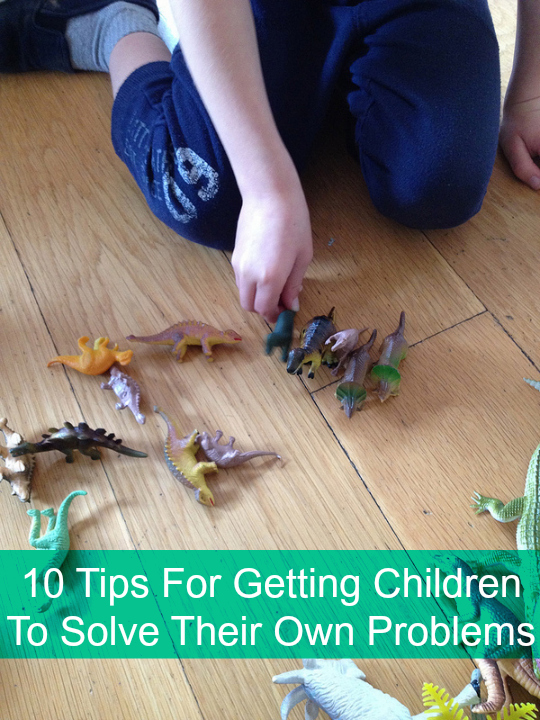
I strongly encourage my children to make attempts to solve their own problems, as are appropriate for their ages. I want them to know that they can come to me for help, but that they need to be responsible for solving the problem. This like all things in the parenting handbook does not work perfectly! There are times when for the health and safety of all concerned mum has to step in, but in general these are some of the things that I do, to help the children solve their own problems:
(1). Have clearly defined limits and be consistent in implementing them
Once children know what is or isn’t allowed, children can then start to identify, evaluate and select appropriate solutions to their problems.
(2). Help children understand their emotions
It is difficult to think clearly when you are very angry or frustrated. By teaching children to understand and be able to label their emotions, they can then begin to distinguish their emotions from the problem and find workable solutions.
(3). Ask thoughtful questions
This is particularly helpful for younger children, as it will encourage logical thinking processes without ownership of the problem changing to the parent.
(4). Guide them to break the problems into chunks
A little like teaching them to read a new difficult word, by breaking it down into smaller parts, it can make the problem not seem so overwhelming.
(5). Assure them that you know that they can deal with the problem
Often it can be a habit for children to come directly to mum or dad when problems arise. If you know that they are easily capable of solving the problem (and they haven’t even tried yet!), explain that you have confidence in their ability to give this problem some thought and find a workable solution.
(6). Don’t rush in to solve their daily problems
And this means from even a very early age. If a toddler is getting frustrated with a puzzle (age appropriate of course 🙂 ), don’t take over and show them how to do it. To learn problem solving skills, children need to develop persistence and logical thinking skills. This can’t occur if mum or dad fixes everything for them.
(7). Encourage creative thinking
Solutions come from ideas. To generate these ideas children will need to learn to think creatively. Encouraging creative thinking through out daily life, will assist children in developing problem solving skills.
There are many ways in which this can be done for example, writing funny stories, building blocks, construction from recycled materials, examining “what if” scenarios through to a conclusion and parents can set an example by speaking aloud, the thinking process they use to solve problems.
(8). Give children opportunities to explore and experiment in an unstructured environment
Children need time to follow their curiosity and play with cause and effect on their own terms.
(9). Allow children to make mistakes
It is easy for an adult to see whether a child’s construction, is going to be stable enough to stand before it is completely built. If the adult interrupts and corrects this mistake instantly, the child may not learn what was wrong.
If the child though, builds the construction, it then falls over, they then have an opportunity to solve the problem – use reasoning and logic skills to and it stable.
(10). Teach children about empathy
Quite often the problem a child faces is to do with another child’s wants or needs versus their own. Although it takes time for this concept to sink in, it is helpful to talk about empathy with children – what it is and how we should use it, at times when they are calm and are not feeling threatened. Then when they are in a situation where they have competing needs, they can start to understand that their emotions not only the only ones involved in the situation.
In what ways do you encourage your children to solve their problems?